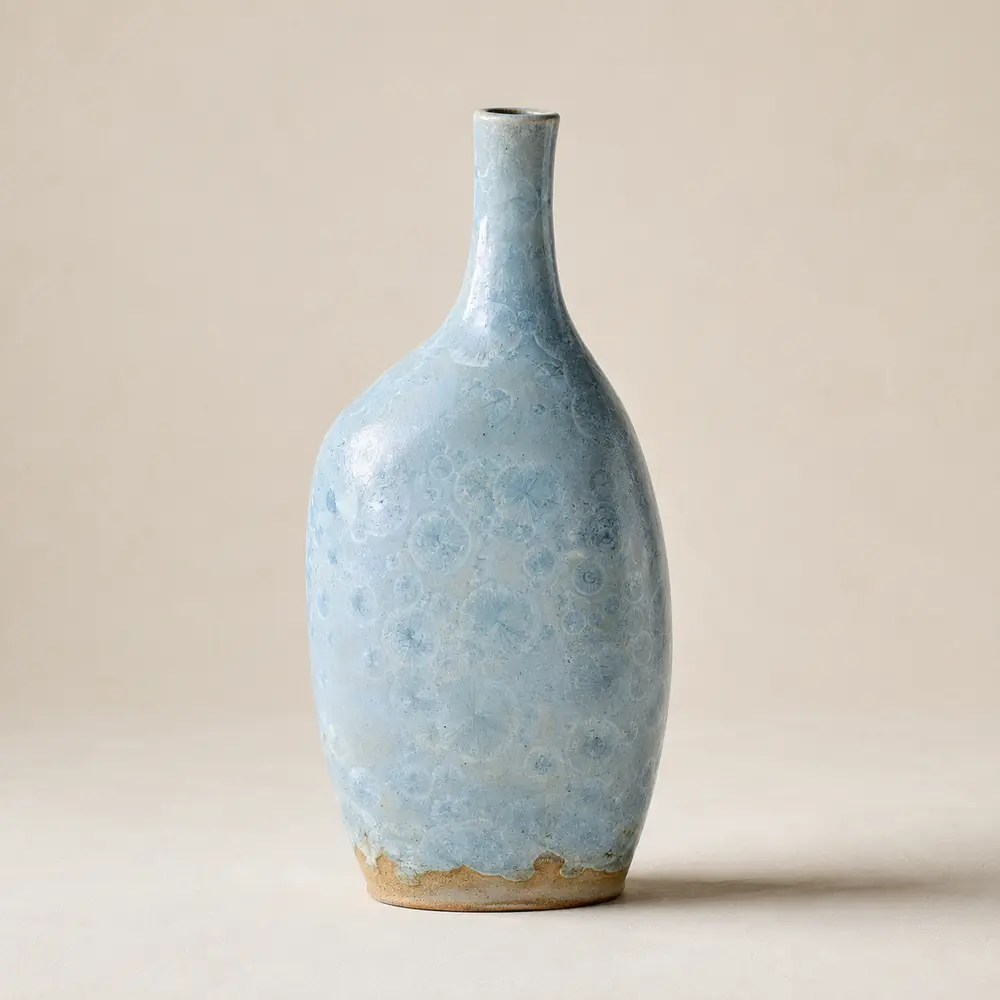
Crystalline glaze can look spontaneous, but it is not random. The recipe, glaze thickness, peak temperature, time at heat, and cooling schedule all create conditions in which crystals are more or less likely to grow.
The useful comparison is weather. A forecast can describe the conditions for a storm without determining where every drop will land. In the kiln, chemistry establishes possibility; thermal history turns that possibility into a specific surface.
The recipe is only the first instruction
A glaze test begins with measured materials, but its behavior cannot be understood from the formula alone. The clay beneath it contributes color and texture. Application thickness affects how freely the glaze moves. Vertical surfaces pull material downward, creating different zones at the shoulder, body, and foot.
Small changes can separate a quiet mineral field from large, distinct crystals. That sensitivity is why tests are labeled and compared rather than judged as isolated successes. A striking result is useful only if the studio can understand enough of its conditions to pursue it again.
Cooling is an active stage
Peak temperature melts and combines the glaze materials. Controlled cooling gives crystals time to form and develop. Holding within one temperature range may encourage growth; moving through it more quickly may leave a finer pattern. Kiln placement adds another variable because no firing chamber is perfectly uniform.
The aim is repeatable character, not a copied pattern. The glaze should belong to the collection while still recording its own firing.
Reading the whole surface
Crystal size is only one measure of a result. The studio also looks at background color, gloss, movement, edge quality, and the transition near the foot. An exciting center with a weak rim is not a resolved glaze. Neither is a dramatic surface that obscures the form beneath it.
The strongest tests support the silhouette at normal viewing distance and reward closer attention without becoming visually noisy. Those are the surfaces that move forward into Collection 001—and the reason every finished piece will be photographed individually before it is offered.