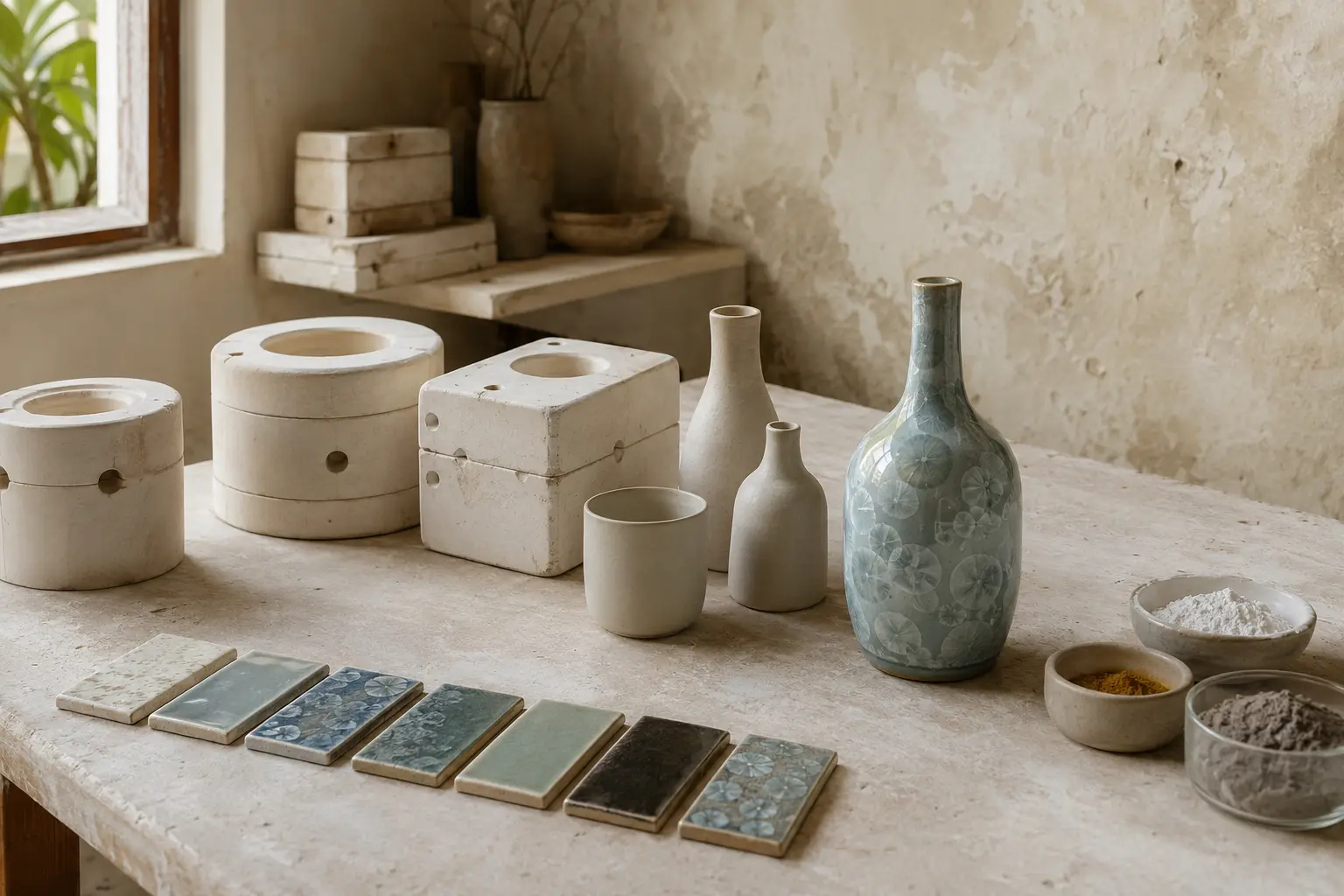
A mold carries the memory of a handmade original. It remembers the curve of a wheel-thrown shoulder, the width of a foot, the angle of a hand-built wall, and the transition into a neck. What it does not contain is a finished ceramic object.
That distinction matters. Mold-making gives a small collection consistency, but the stages that follow determine whether the result feels mechanical or considered. Clay thickness, release time, seam finishing, drying, glaze application, firing, and final inspection all change what the handmade form becomes.
The form is a fixed question
Before a mold is made, the form moves through physical versions. On the wheel, clay can be expanded, collared, compressed, cut, and joined. Hand building allows planes, seams, additions, and asymmetries that do not need to revolve around a center. The original is refined until it carries its weight correctly, then used as the master for a plaster mold.
Fixing the question is useful. If every test began with a different silhouette, it would be difficult to know whether a result came from the form, the material, or the firing. A stable mold, taken from a resolved handmade original, lets the studio change one variable at a time and see more clearly what the ceramic process is doing.
Clay introduces its own tolerances
Liquid clay builds against the porous plaster wall, but it does not become a neutral copy. Casting time affects wall thickness. The piece contracts as it dries and again as it fires. A neck can move slightly; a broad plane can tighten; a rim must be cleaned without losing the character designed into it.
Seams are removed and surfaces are refined by hand. The aim is not to erase every sign of process until the object looks synthetic. It is to keep accidental marks from competing with the deliberate ones. Each piece earns its way to glazing by surviving that inspection.
The mold protects the relationship between the parts. The kiln decides how that relationship finally feels.
Glaze redraws the object
Glaze can make the same form appear heavier, softer, sharper, or more distant. A dark satin surface emphasizes the outline and makes a vessel feel compact. A pale crystalline surface catches light across the body and can make the same volume feel larger. Where glaze thins over an edge, the geometry becomes more visible; where it pools, the eye slows down.
Application is therefore part of the design rather than a final coat of color. Thickness is measured and adjusted. Test tiles provide direction, but a glaze on a vertical bottle behaves differently from the same material on a flat sample. Gravity, heatwork, and cooling all become visible in the finished surface.
Why the final listing shows the actual piece
A small-run method can hold dimensions and silhouette within a useful range, but it should not pretend that kiln-developed surfaces are interchangeable. Decker Pottery previews show the intended family of form and finish. Release listings will show the specific finished object, including its measurements, surface variation, and condition.
The mold makes a collection possible. The differences produced after the mold are what make choosing one piece over another worthwhile.