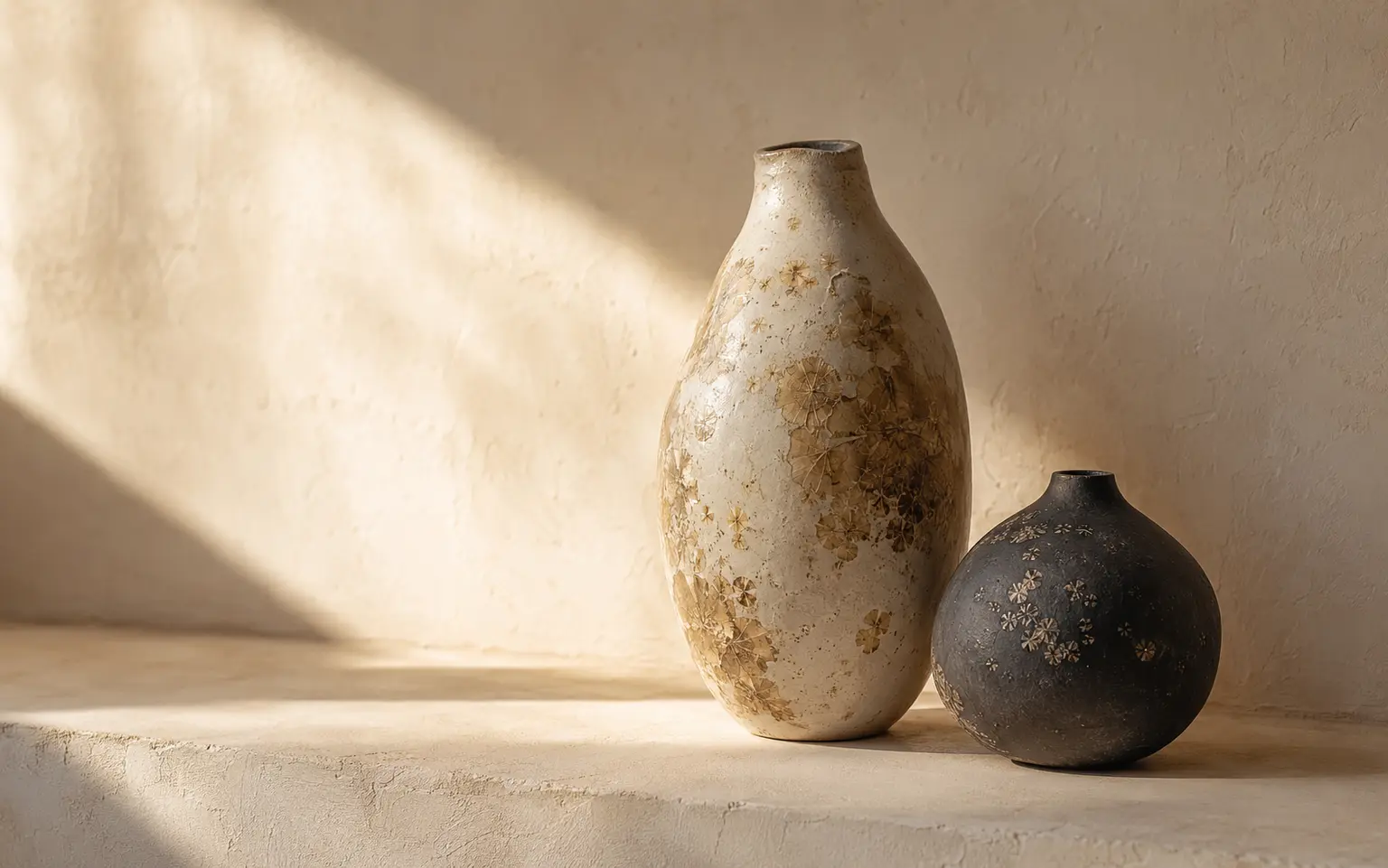
The bottle is one of the simplest ceramic forms to recognize and one of the hardest to resolve. A body, a shoulder, a neck, and an opening are enough to make the object legible. They also leave very few places for an uncertain decision to hide.
That directness is why Collection 001 begins here. Before the studio expands into tableware or more complicated sculptural objects, the bottle gives us a disciplined place to establish a language: how much volume a form should carry, where its weight appears to sit, how abruptly a shoulder should turn, and how a surface should move across it.
A silhouette understood before it is decorated
A useful test for a vessel is to remove the glaze from the conversation. If the profile were reduced to a dark shape on white paper, would it still have character? Would it feel upright or resting, tense or settled, familiar or slightly strange? The bottle makes those questions unavoidable because its identity is read almost entirely from the outside.
Wide bowls and cups invite attention to the interior. A bottle’s narrow opening closes that view and turns the eye back toward the contour. The line from foot to shoulder becomes the subject. Even a change of a few millimeters at the neck can make the whole object feel more precise, more fragile, or more grounded.
The goal is not a perfect geometric object. It is a form whose imbalance feels intentional enough to become its identity.
The neck is not an afterthought
Much of a bottle’s character is decided where the body becomes the neck. A gradual transition feels calm and continuous. A sharper shoulder creates tension and makes the volume below it appear fuller. A long neck exaggerates vertical movement; a short one lets the body dominate.
At the wheel, these relationships are worked out directly in clay. A body can be widened, a shoulder lifted, or a neck collared until the proportions begin to hold together. Hand-built additions, cuts, and joins create another route to forms the wheel alone cannot make. The strongest handmade original can then become the master for a plaster mold.
Repetition without sameness
Once a handmade original is selected, mold-making preserves its essential geometry and the character established by the hand. That matters for a small collection because several pieces can share the same proportion while the ceramic process creates meaningful differences between them. The mold holds the silhouette steady; casting thickness, drying, cleanup, glaze application, kiln position, and cooling history keep the results from becoming identical.
This is especially useful with crystalline and mineral surfaces. A repeated form becomes a controlled field for watching a glaze change. On one piece, crystals may gather near the shoulder. On another, the same glaze may open into quieter areas or break warmer over an edge. The form provides continuity while the firing records a different event.
A surface needs room to move
The early bottle studies use broad, uninterrupted areas for a reason. Highly active glazes need space. Too many handles, ridges, or decorative interruptions can compete with the movement already happening in the surface. A restrained form allows color, crystal growth, and changes in sheen to remain visible from a distance and become more detailed as the viewer approaches.
That restraint is not the absence of design. The foot determines how the object meets the table. The shoulder controls how light travels across it. The neck gives a visual pause before the opening. Each part is quiet, but each has work to do.
Why this matters when choosing a finished piece
Collection previews establish a direction, not a promise that every firing will reproduce one exact surface. When finished pieces are released, each listing will show the actual object being offered. Buyers will be able to judge the specific crystal pattern, color movement, dimensions, foot, opening, and any natural evidence of the firing before purchasing.
The bottle makes that individual selection especially rewarding. Two pieces can share a silhouette and still carry very different visual weight because of their surfaces. One may be pale and atmospheric; another darker and more graphic. The underlying form connects them, but neither needs to substitute for the other.
What Collection 001 is testing
The first group is deliberately focused. It tests a family of related volumes, several neck and shoulder transitions, and surfaces that range from quiet mineral fields to more active crystal development. Some studies will be revised. Some will stop at the test stage. The strongest combinations will become the first finished release.
Beginning with the bottle keeps that process legible. It gives the studio a clear standard: the form must hold attention before the glaze arrives, and the glaze must deepen the form rather than rescue it. That is a useful foundation for everything that follows.